
Web3 Developers Are Tired of Hype: Here’s Why Support Is the New Code
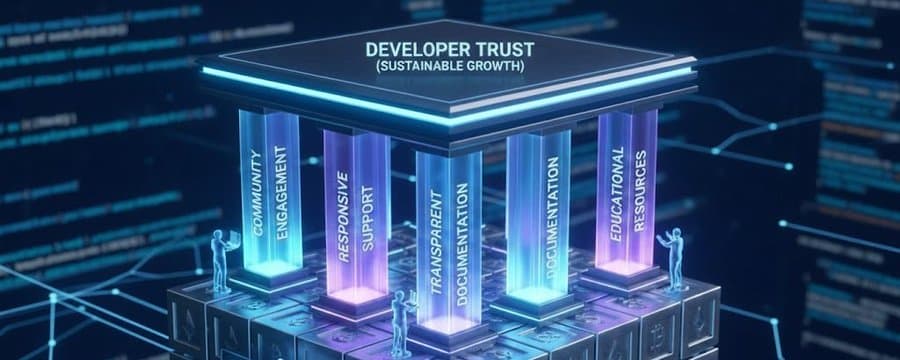
Code helps to build, but support helps to scale: A builder insight
Trust in Web3 is earned at 3 AM. It is earned when a developer is stuck on a breaking change and finds a human response in Discord (and not only AI annoying bots) rather than a dead link in the documentation. In a decentralized world, code is only the starting point. The real differentiator is how a project supports the people building on top of it. I spent 30+ hours analyzing top Web3 developer forums and industry-leading X threads to understand what actually keeps builders in an ecosystem. The data is clear. Developers do not just follow the tech. They follow the people who help them build it. Trust is the common factor for all future growth. Here is why I believe support and community are the true glue of Web3 innovation.
3 Common Pitfalls That Make Developers Leave a Project
Even with great technology, many projects fail because they ignore the human element. From my perspective, there are three main trust killers:
1. The Ghost Town Effect
This happens when a team focuses entirely on the code but leaves their social channels empty. If I ask a technical question and get no answer for 48 hours, I'm out. My time is too valuable to wait on a silent team.
2. The Hype Trap
I often see projects prioritize moon tweets over technical updates. As a builder, I'm trained to look for substance. When a project is marketing-heavy but has zero documentation or active GitHub commits, I label it a high-risk venture and move on.
3. Siloed Fragmentation
Many projects fail to provide the interoperability tools or educational resources needed to connect with other protocols. This forces builders to do extra work just to make basic integrations. Without shared resources, the friction becomes too high to stay.
Stewardship Over Top-Down Control: Learning from Ethereum Improvement Proposals (EIP)
Modern Web3 trust is built on responsive support and transparency. We see this in the way industry leaders like Tim Beiko manage the Ethereum ecosystem. He emphasizes that the network thrives on an open, collaborative process.
Anyone can propose an Ethereum Improvement Proposal (EIP). Anyone can contribute to the research.
This is not top-down control. This is stewardship. Trust is built when the black box of development is removed. When developers see that they can influence the protocol, they become stakeholders.
This level of accessibility is a form of support that code alone cannot provide. It creates a culture where the community feels safe to invest their time and resources.
Real-World Examples of How Top Platforms Are Doing Things Right
Several Web3 projects stand out for their developer support through grants, APIs, and responsive communities. These initiatives help developers build faster and integrate seamlessly into the ecosystem.
Alchemy
Alchemy provides robust APIs and tools that act as a scaling partner for thousands of projects. They offer partnerships with networks like Polygon to provide infrastructure and grants.
Their developer tools include real-time data and SDKs. These tools ease the burden of dApp development across multiple chains. By providing reliable scaling solutions, they remove the technical friction that often kills new projects.
Arbitrum
Arbitrum offers advanced technical tools. Their Stylus upgrade allows you to write smart contracts in Rust, C, and C++, lowering the entry barrier for developers. They also offer grant programs to provide milestone-based funding, while initiatives like ArbiFuel help onboard users by sponsoring gas fees.
iExec
iExec stands out by offering specialized 1:1 guidance through their DevRel & Ecosystem Managers. They provide the support needed to build confidential RWA and DeFi apps. The Ecosystem Fund is another major opportunity for developers to access technical resources, financial support, and a network of blockchain leaders to build their product.
Polygon
Polygon offers ecosystem grants via its DAO and hosts frequent hackathons. They maintain active Discord channels for real-time help. Their community events prioritize developer needs over just the underlying technology. They understand that a protocol is only as strong as the community that builds on it.
Shipping Progress as a Trust Signal
In the Web3 space, developers trust teams that ship in public. When a project shows consistent on-chain progress, it signals legitimacy to the entire community.
Shipping is a support task because it reduces the developer’s risk. Every new tool or update is an unblocker for the community. If you stop shipping, you leave your developers stranded on a stagnant platform.
Transparency about challenges and trade-offs is equally important. Being honest about what is not working builds more trust than a polished PR statement. Developers are used to bugs. They are not used to being ignored.
Documentation and Practical Tooling
Trust is also a matter of efficiency. Trust Wallet exemplifies this by scaling to 200 million users through proactive support and scam prevention. They provide in-depth guides on Account Abstraction SDKs to ensure a seamless experience for builders.
If I can't understand how to build on your protocol within ten minutes, the project has failed me. High-quality documentation is the first line of support.
Providing SDKs that simplify complex tasks is a signal that you value the developer’s time. When you make it easy to build, you make it easy to trust.
How to Build Lasting Trust
The consensus among successful Web3 leaders is that developers are tired of the hype. They want usable products and strategic partnerships. They want to see that a project has a sustainable model and a team that stays engaged.
To build lasting trust, follow the lead of the most successful ecosystems:
- Prioritize human-assisted support over automated bots
- Treat your documentation as a living product that requires constant updates
- Use grants to build relationships rather than just buying temporary users
- Engage in daily storytelling and real-time responses on social platforms like X
Your code is immutable, but your reputation is built every single day. If you support your developers, they will build your future for you.